Decision trees are one of the most intuitive and interpretable machine learning algorithms. They allow a model to make decisions by asking a sequence of step‑by‑step questions, branching at each answer, and narrowing down possibilities until it reaches a final conclusion. Just as a person solves a problem by eliminating options, a decision tree follows a structured path: at each step it asks a yes/no or multi‑choice question and directs the input to the correct branch.
Scientifically, decision trees work by repeatedly splitting the dataset based on specific features. Each split aims to make the resulting groups as “pure” as possible—meaning that each branch contains examples that mostly belong to a single class. When new data arrives, the model simply follows the same path through the tree to make a prediction.
Here is how a decision tree generally operates:
- It examines all available features in the dataset.
- It selects the feature that best separates the data (for example, age, temperature, exam score).
- It splits the data into two or more branches based on that feature.
- It repeats this process for each new branch.
- The tree grows until no further meaningful splits can be made.
This structure makes decision trees both powerful and transparent. They reveal why the model reached a particular conclusion, which is essential in fields like healthcare, law, education, and finance—areas where accountability and interpretability matter.
Why Are Decision Trees Important?
Many AI systems operate like a “black box,” offering predictions without explaining how they were made. Decision trees break this opacity. They clearly show which feature influenced the decision at each step and how the final outcome was reached. This transparency is why they are widely used in ethical, safety‑critical, and high‑impact decision environments.
A Simple Example:
Imagine you want to predict someone’s favorite ice‑cream flavor. A decision tree might look like this:
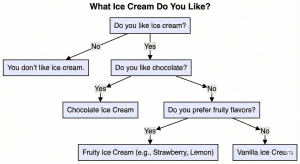
This simple branching logic captures the essence of how decision trees operate: ask a question, follow the answer, and keep narrowing the possibilities.
Of course, decision trees also have limitations. If a tree grows too deep, it can become overly sensitive to small details in the training data—a problem known as overfitting. An overfitted model performs well on the data it has memorized but struggles with new examples. For this reason, tree depth, splitting criteria, and stopping rules must be carefully managed.
In summary, decision trees are a foundational part of machine learning. Their clarity, interpretability, and structured logic make them ideal for understanding how AI systems reason. When properly designed, they offer fast, transparent, and reliable predictions—making them indispensable tools in modern artificial intelligence.
Discover more from aitohope.org | AI for Youth: Artificial Intelligence Literacy & Education
Subscribe to get the latest posts sent to your email.