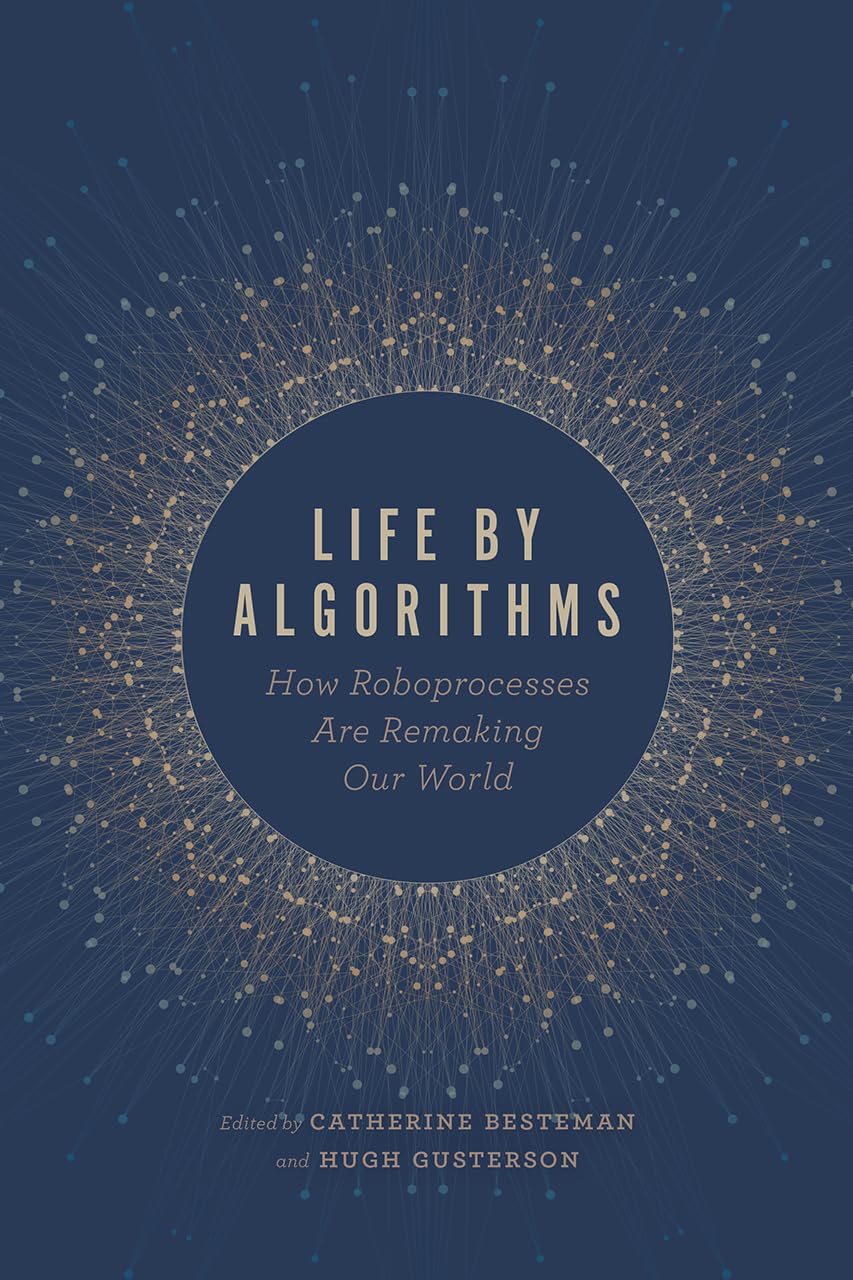
Life by Algorithms: How Roboprocesses Are Remaking Our World
Life by Algorithms: How Roboprocesses Are Remaking Our World, edited by Catherine Besteman and Hugh Gusterson, does not begin with futuristic machines or hypothetical superintelligence. Instead, it looks at something far more immediate: the automated systems that already influence education, housing, immigration, criminal justice, workplaces, emotions, and surveillance.
The central idea of the book is the concept of “roboprocesses”—automated, standardized, and data-driven procedures that increasingly make or shape decisions once handled through direct human judgment. These processes may appear neutral because they rely on rules, numbers, categories, and algorithms. Yet the contributors show that automation does not automatically produce fairness or rationality. In some cases, it can reproduce existing inequalities, remove context from important decisions, and make harmful outcomes appear objective simply because they have been processed by a system.
Unlike many books about artificial intelligence, Life by Algorithms is not primarily concerned with what machines may become in the future. Its question is more immediate:
What happens when human institutions begin to think and act like machines?
The book examines this question through case studies written by scholars from anthropology, communications, international studies, and political science. Rather than treating algorithms as isolated pieces of software, the authors investigate the institutions, incentives, classifications, and assumptions that surround them.
What does the book mean by “roboprocesses”?
A roboprocess is not necessarily a robot.
It can be a scoring system, an automated eligibility procedure, a standardized test, a bureaucratic classification, a ranking mechanism, or an algorithm that determines what happens next.
The important point is that complex human situations are translated into standardized inputs and predefined categories. Once this happens, the system can operate quickly and consistently—but it may also lose information that does not fit neatly into its structure.
A homeowner becomes a financial risk score.
A student becomes a test result.
A person moving through the immigration system becomes a case category.
A teacher becomes a performance metric.
Human lives are not literally transformed into numbers, but increasingly consequential decisions about those lives are made through numerical and automated representations.
This is the tension at the center of Life by Algorithms: efficiency can increase at the same time that human judgment decreases.
The book explores algorithmic life through three major areas
1. Categories
The first section shows how institutions classify people and how those classifications can determine access, opportunity, punishment, or exclusion.
Noelle Stout examines automated decision-making during the U.S. foreclosure crisis. Her research shows how mortgage-assistance systems standardized decisions about homeowners and, in many cases, created rigid procedures that prevented meaningful human intervention. Automated systems intended to improve efficiency could introduce errors while still appearing objective and authoritative.
Anne Lutz Fernandez and Catherine Lutz then turn to “roboeducation.” Their chapter examines the expansion of standardized testing, scripted curricula, teacher evaluation systems, and numerical performance measurements in American education. The broader question is not simply whether testing is useful, but what happens when educational institutions begin treating learning as something that can be completely captured through standardized measurements.
The following chapters extend this issue of classification into immigration detention and the criminal justice system. Susan J. Terrio examines the detention and deportation of children in U.S. immigration custody, while Keesha M. Middlemass explores how a felony conviction can function as a kind of long-term automated social category—continuing to shape access to employment, housing, and other opportunities long after the original legal judgment.
Together, these chapters make an important point: categories do not merely describe people. Once embedded in institutions, they can determine what people are allowed to do.
2. Emotions
The second section moves into a less obvious territory: feelings.
We often imagine automated systems as cold and emotionless. But Life by Algorithms asks whether technology can also organize, measure, influence, or commercialize emotional life.
Alex Blanchette examines industrial agricultural systems and how biological life itself can become organized around standardized production processes.
Robert W. Gehl’s chapter on “Emotional Roboprocesses” looks directly at systems designed to capture and structure human emotion. He examines the intersection of social media, consumer capitalism, marketing, identity, surveillance, and emotional expression. His argument complicates the familiar idea that machines are rational while humans remain emotional: digital systems increasingly observe, classify, respond to, and attempt to shape those emotions.
This becomes especially relevant in the age of recommendation algorithms, social platforms, personalized advertising, and conversational AI. The question is no longer only whether technology understands what we click.
It is also whether technology begins to influence what we want, feel, notice, and value.
3. Surveillance and Quantification
The final section focuses on surveillance and the growing authority of numbers.
Joseph Masco examines the expansion of surveillance into everyday life, while Sally Engle Merry investigates how numerical indicators increasingly shape governance and decision-making.
Merry’s chapter asks readers to reconsider something that often appears completely neutral: measurement.
GDP, credit ratings, university rankings, performance indicators, development goals, and other numerical systems are frequently treated as objective descriptions of reality. Yet deciding what to measure, how to measure it, and which variables matter already requires human judgment.
Once created, however, indicators can begin influencing the very institutions they were designed to describe.
A ranking can change how a university behaves.
A performance metric can change how an employee works.
A test score can change how a school teaches.
A risk score can change how an institution treats a person.
In other words, numbers do not simply represent the world.
Sometimes, they reorganize it.
Why this book matters in the age of AI
Life by Algorithms was published in 2019, before generative AI became part of everyday public life. Yet many of its questions have become even more important.
Modern discussions about AI often focus on model performance: accuracy, speed, intelligence, or capability.
This book forces us to ask another set of questions:
Who defines the categories?
Which data are considered important?
What happens to people who do not fit the model?
When should automated decisions be challenged by human judgment?
Who is responsible when an apparently neutral system produces unequal outcomes?
This is one of the book’s greatest strengths. It moves the discussion away from the idea that the main ethical problem is simply whether an algorithm is technically accurate.
An algorithm can operate exactly as designed and still be part of an unfair system.
For students interested in AI ethics, this distinction is essential.
Why AItoHope recommends this book
1. Understanding Algorithmic Power — The book shows that algorithms do more than calculate information. When embedded in institutions, they can influence access to education, housing, employment, justice, and public services.
2. Looking Beyond Technical Bias — It encourages readers to examine not only whether an algorithm is biased, but also who created its categories, which values are built into its rules, and what happens when complex human situations are reduced to standardized data.
3. Connecting AI with Society — Through examples from education, finance, immigration, criminal justice, surveillance, and emotional life, the book demonstrates why understanding AI requires more than computer science. Sociology, anthropology, ethics, politics, and philosophy are equally important.
4. Developing Critical AI Literacy — Life by Algorithms trains readers to ask a question that is central to AItoHope’s mission: when a system makes a decision, should we only ask whether it works—or also what kind of world that system is helping to create?
Discover more from aitohope.org | AI for Youth: Artificial Intelligence Literacy & Education
Subscribe to get the latest posts sent to your email.