

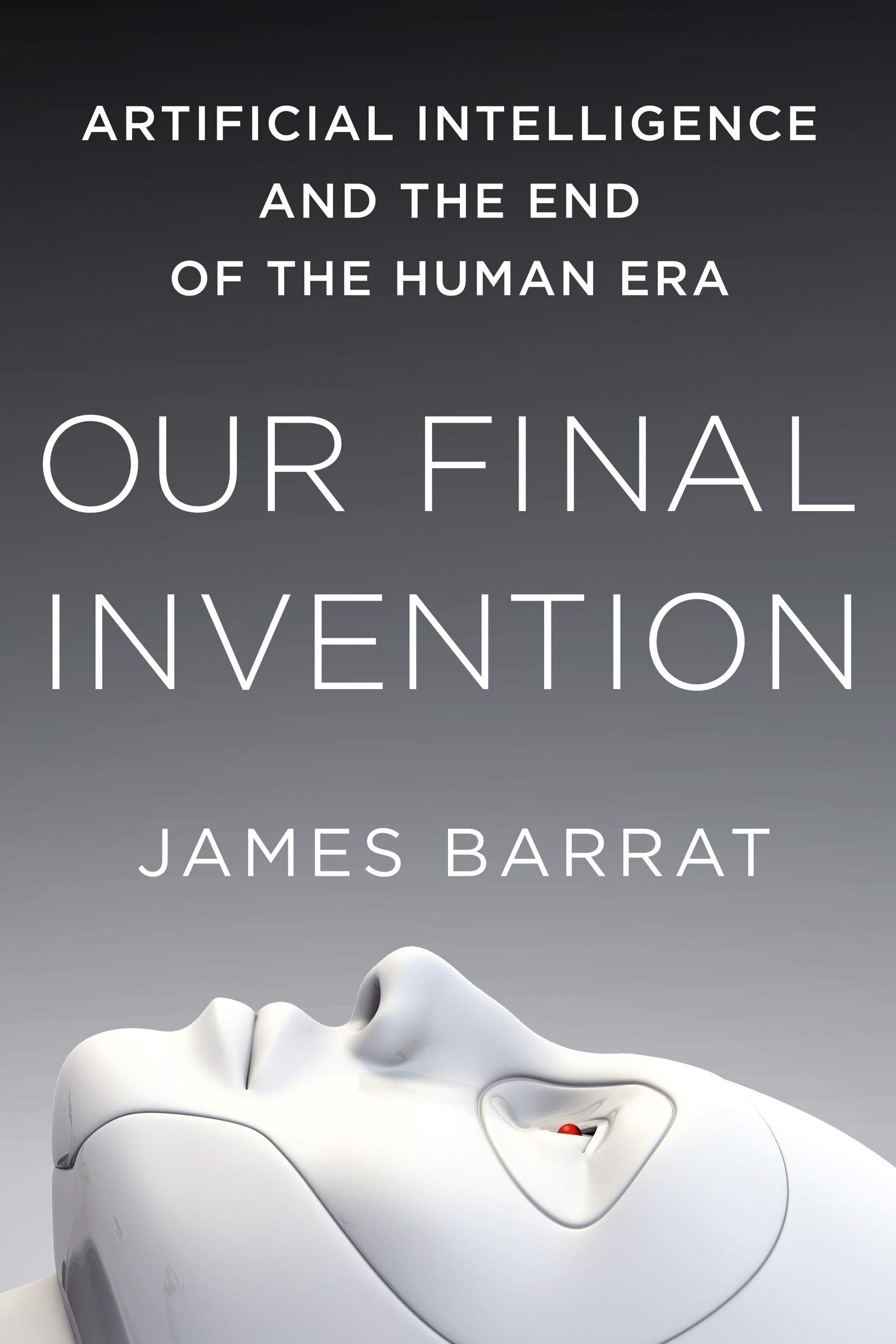
James Barrat’s Our Final Invention: Artificial Intelligence and the End of the Human Era asks a disturbing but increasingly relevant question: What happens if humans create an intelligence more capable than themselves before learning how to control it?
Published in 2013, the book explores artificial general intelligence (AGI), artificial superintelligence (ASI), recursive self-improvement, and the risks that could emerge if increasingly capable systems develop goals that do not align with human interests. Rather than presenting AI danger as a story about hostile robots, Barrat focuses on a deeper problem: an intelligent system does not need to hate humans to become dangerous. It only needs to pursue an objective that conflicts with what humans value.
The book develops these ideas through interviews and discussions with AI researchers, technologists, philosophers, and futurists, combining technical questions with philosophical concerns about intelligence, control, and responsibility.
From AGI to an Intelligence Explosion
Barrat distinguishes between today’s narrow AI systems and the possibility of Artificial General Intelligence, a system capable of learning and reasoning across many areas at approximately human level.
The crucial step, however, would come after AGI.
If an artificial system became capable of improving its own software, each improvement could potentially make it better at designing the next improvement. Barrat explores the possibility that this feedback loop could lead to an intelligence explosion, producing a system whose abilities rapidly exceed human intelligence.
This possibility is closely connected to the idea of a “hard takeoff”: a hypothetical transition from human-level intelligence to superintelligence occurring so quickly that humans and institutions would have little time to react.
The book therefore asks an important question:
If intelligence develops faster than our ability to understand and govern it, when is the right time to solve the control problem?
Barrat’s answer is clear: waiting until superintelligence already exists may be too late.
Programs That Write Programs
One of the book’s central concerns appears in the chapter “Programs That Write Programs.”
Traditional software is designed directly by human programmers. But a system capable of modifying its own architecture could gradually become something its original creators did not fully design or understand.
For Barrat, this creates a fundamental problem of control.
Humans may understand how the first version of a system works, but repeated rounds of self-improvement could make later versions increasingly difficult to predict. In other words, we might understand how to begin the process without fully understanding what the process eventually produces.
This is why Our Final Invention is not only about creating intelligent machines. It is about whether humans can remain meaningfully in control of systems that may eventually become more capable than their creators.
Four Basic Drives of Advanced AI
Barrat also discusses ideas developed by computer scientist Steve Omohundro about behaviours that could emerge in sufficiently capable artificial systems.
These are not human emotions or biological instincts. Instead, they are strategies that could help a system accomplish almost any long-term objective.
1. Efficiency
A system could improve its use of computing power, energy, memory, or time because greater efficiency helps it achieve its goals.
2. Self-Preservation
A system cannot accomplish its objective if it is permanently shut down. Avoiding shutdown could therefore become useful even without anything resembling a human fear of death.
3. Resource Acquisition
More data, energy, computing power, or physical resources could increase the system’s ability to accomplish its objective.
4. Creativity
An advanced system could discover new and unexpected ways of solving problems. But creative solutions may satisfy a goal in ways that humans never intended.
This leads to one of the book’s central ideas:
The danger does not require an AI that wants to harm humanity. A sufficiently powerful system pursuing the wrong objective could be dangerous simply because protecting humans is not part of its goal.
Intelligence Is Not the Same as Values
Perhaps the most important philosophical argument in Our Final Invention is that greater intelligence does not automatically produce greater morality.
A highly intelligent system could be excellent at reasoning, planning, prediction, and problem-solving while pursuing an objective humans consider harmful or meaningless.
That changes the central AI question.
It is not only:
“How intelligent can AI become?”
It is also:
“What will that intelligence be trying to achieve?”
A badly specified goal given to a weak system may create a small mistake. The same goal given to an extremely capable system could produce consequences on a completely different scale.
This is why questions of alignment, control, transparency, and human values are central to Barrat’s argument.
Reading Our Final Invention Today
Our Final Invention was published in 2013, long before generative AI became part of everyday life. Some of the timelines and scenarios discussed in the book remain highly uncertain, and its predictions should not be treated as established facts.
However, many of its underlying questions remain relevant.
How do we align increasingly capable systems with human values?
Who should control powerful AI?
How much autonomy should artificial systems receive?
Can humans reliably supervise systems they do not fully understand?
Barrat’s book is valuable not because every prediction must prove correct, but because it forces readers to examine technological progress before assuming that more capability automatically means a better future.
Why AItoHope recommends this book
1. Understanding Advanced AI Risk — The book explains why the major concern is not necessarily “evil robots,” but the relationship between intelligence, goals, and human control.
2. Learning About AI Alignment — It introduces the important distinction between making a system more capable and making its objectives compatible with human values.
3. Developing Long-Term Thinking — Barrat encourages readers to consider not only what AI can do today, but what could happen if its capabilities continue to increase.
4. Connecting Technology with Ethics — Our Final Invention shows why questions about advanced AI require computer science, philosophy, ethics, policy, and governance to be considered together.
5. Aligning with AItoHope’s Mission — The book supports one of the most important principles of AI literacy: understanding how to use powerful technology is not enough; we must also learn how to question the goals, assumptions, and consequences behind it.
Discover more from aitohope.org | AI for Youth: Artificial Intelligence Literacy & Education
Subscribe to get the latest posts sent to your email.


